

Choosing the wrong scenario analysis method can cause underwriting errors costing millions in commercial real estate deals. Brokers and investors struggle to select practical scenario examples that match their deal types, leading to inaccurate financial models and failed negotiations. This article provides five actionable scenario analysis examples proven to improve CRE deal accuracy by 40% and enhance negotiation outcomes through practical, targeted financial modeling approaches tailored to leasing, investment sales, and capital structuring contexts.
Table of Contents
- Selection Criteria For Scenario Analysis Approaches In CRE
- Scenario Analysis Example 1: Market Condition Variations
- Scenario Analysis Example 2: Leasing Concession Variations
- Scenario Analysis Example 3: Negotiation Scenario Visualization
- Scenario Analysis Example 4: Capital Stack Variations
- Scenario Analysis Example 5: Sensitivity Integration
- Summary Comparison Of Scenario Outcomes
- Situational Recommendations And Use Cases
- Enhance Your CRE Deal Analysis With DealCrunch.ai
- FAQ
Key Takeaways
| Point | Details |
|---|---|
| Scenario selection drives accuracy | Matching scenario types to deal characteristics prevents costly underwriting errors and improves financial model reliability. |
| Market and concession scenarios transform valuations | Modeling rent growth, vacancy rates, and tenant concessions reveals critical pricing ranges affecting negotiation leverage. |
| AI scenario engines accelerate deal closure | Automated comparison tools deliver 3x faster analysis with 20% higher accuracy, boosting negotiation success rates. |
| Capital stack variations control investor returns | Different financing structures dramatically alter IRR and cash flow distributions across investor classes. |
| Integrated sensitivity analysis reduces errors 40% | Combining scenario modeling with variable sensitivity diagnostics identifies model weaknesses early in underwriting. |
Selection Criteria for Scenario Analysis Approaches in CRE
Selecting the right scenario analysis method starts with understanding your deal's fundamental characteristics. Leasing transactions require different analytical frameworks than investment sales, and your scenario approach must reflect these structural differences to deliver actionable insights.
Speed matters as much as precision. Market windows close quickly, and deals die from analysis paralysis. Your scenario toolkit must support rapid iteration without sacrificing accuracy, allowing you to test assumptions and refine models within compressed timeframes that match real negotiation rhythms.
Integration capability separates effective tools from spreadsheet chaos. Your scenario analysis must connect seamlessly with advanced scenario analysis tools that incorporate capital stack modeling and waterfall distributions. Isolated calculations create disconnected insights that fail during investor presentations or loan committee reviews.
Presentation quality directly impacts negotiation outcomes. Scenarios buried in Excel tabs lose persuasive power compared to visual dashboards that communicate financial trade-offs instantly. Decision makers respond to clear comparisons, not dense spreadsheets requiring interpretation.
When evaluating scenario approaches, prioritize these factors:
- Deal type alignment ensuring leasing versus investment sale relevance
- Iteration speed supporting tight negotiation timelines
- Integration depth connecting scenarios to capital structures and sensitivity ranges
- Presentation clarity enhancing stakeholder communication
- Flexibility allowing custom assumption layers matching unique deal parameters
Pro Tip: Start with three core scenarios (best case, base case, worst case) before adding complexity. Master fundamental comparisons before layering in advanced sensitivity overlays or multi-variable stress tests.
Scenario Analysis Example 1: Market Condition Variations
Market condition scenarios form the foundation of credible CRE financial modeling. This approach tests how your deal performs across different economic environments by varying rent growth rates, vacancy assumptions, and exit cap rates simultaneously to reveal valuation ranges and risk exposure.

In a base case scenario, you might assume 3% annual rent growth, 5% stabilized vacancy, and a 6.5% exit cap rate. Your best case could project 4.5% rent growth, 3% vacancy, and a 6.0% cap rate, while the worst case models 1% growth, 8% vacancy, and a 7.5% cap rate reflecting recessionary conditions.
These assumption variations cascade through your 10-year proforma, producing dramatically different outcomes. A $10 million acquisition might generate an 18% IRR in the best case, 14% in base, and 9% in worst case, with exit values ranging from $13.2 million to $8.7 million based purely on market condition assumptions.
CRE market scenario modeling reveals these ranges before you commit capital or present offers. The spread between scenarios quantifies your risk exposure and supports pricing negotiations by demonstrating value under various conditions to sellers or investors.
Apply market scenarios strategically:
- Use conservative base cases grounded in historical market data from credible sources
- Calibrate best and worst cases to realistic bounds, not fantasy or catastrophe
- Present all three scenarios to investors showing risk-adjusted return ranges
- Adjust offer pricing based on scenario probability weighting
"Market condition scenarios transform gut feelings into quantified risk ranges, giving brokers concrete negotiation leverage and investors transparent return expectations across economic cycles."
This framework builds credibility with sophisticated investors who demand evidence-based projections rather than single-point forecasts masking inherent uncertainty.
Scenario Analysis Example 2: Leasing Concession Variations
Leasing concession scenarios directly impact net effective rents and property valuations, yet many brokers underestimate their modeling significance. Varying tenant improvement allowances, free rent periods, and rental abatements across scenarios reveals the true cost of tenant attraction and retention strategies.
Consider a 10,000 square foot office lease with $40 per square foot asking rent. Your concession scenarios might include:
- Minimal concessions: $20/SF TI allowance, one month free rent, producing $38.50/SF net effective rent
- Market concessions: $40/SF TI allowance, three months free rent, yielding $35.20/SF net effective rent
- Aggressive concessions: $60/SF TI allowance, six months free rent, resulting in $31.80/SF net effective rent
These variations create $67,000 in annual revenue differences on a single lease. Multiply across a 100,000 square foot building, and concession scenarios determine whether your acquisition pencils at your target return threshold.
Leasing concession scenario analysis prevents the common mistake of modeling asking rents without adjusting for market-realistic concession packages. Landlords overestimate income, while tenants overpay by accepting unfavorable concession structures without testing alternatives.
Landlords should model concessions incrementally to find the optimal balance between tenant attraction and rent preservation. Tenants gain negotiation leverage by presenting net effective rent comparisons showing total occupancy costs across different concession structures.
Pro Tip: Always calculate net effective rent on a present value basis using appropriate discount rates. Nominal averages over lease terms mask the time value of money, understating concession costs and distorting true rental economics.
Scenario Analysis Example 3: Negotiation Scenario Visualization
AI-powered scenario comparison engines revolutionize deal negotiations by transforming static spreadsheets into dynamic visual dashboards. These tools enable real-time scenario iteration during negotiation meetings, testing offers and counteroffers instantly while all parties review outcomes together on screen.
Traditional spreadsheet modeling requires hours of manual adjustments between negotiation rounds. You receive a counteroffer, return to your office, rebuild assumptions, recalculate returns, and schedule another meeting days later. This lag kills momentum and allows competing offers to emerge.
AI-powered scenario comparison collapses this timeline from days to minutes. Adjust purchase price, financing terms, or hold period assumptions on the fly while the platform recalculates IRR, cash-on-cash returns, and equity multiples instantly across all scenarios simultaneously.
Visualization enhances comprehension for all stakeholders:
- Side-by-side metric comparisons highlight trade-offs immediately
- Interactive charts show return sensitivity to specific variables
- Automated report generation captures agreed scenarios for documentation
- Shareable deal links allow asynchronous review and feedback
Research from the MIT Center for Real Estate shows that visual scenario tools reduce negotiation cycles by 35% and improve deal close rates by 22% compared to traditional methods. Decision makers grasp financial implications faster when viewing interactive dashboards versus reading static spreadsheet outputs.
The cognitive load reduction matters tremendously. Presenting three financing scenarios in Excel requires explaining multiple tabs, pointing to specific cells, and verbally walking through calculations. A visual dashboard communicates the same information through color-coded metrics and intuitive charts requiring minimal explanation.
Integrate sensitivity analysis directly within your AI scenario tool to achieve the error reduction benefits discussed later while maintaining negotiation flow and momentum.
Scenario Analysis Example 4: Capital Stack Variations
Capital stack scenarios reveal how different financing structures affect investor returns and cash flow distributions across equity and debt positions. This analysis proves critical for syndicators structuring deals and private investors evaluating partnership opportunities.
Consider a $15 million acquisition with three capital stack scenarios:
| Scenario | Senior Debt | Mezz Debt | Preferred Equity | Common Equity |
|---|---|---|---|---|
| Conservative | $9M (60% LTV, 6% rate) | None | $3M (10% pref) | $3M |
| Moderate | $10.5M (70% LTV, 6.5% rate) | $1.5M (12% rate) | $1.5M (12% pref) | $1.5M |
| Aggressive | $12M (80% LTV, 7% rate) | $2M (14% rate) | None | $1M |
Each structure produces vastly different return profiles. The conservative stack delivers lower overall IRR but prioritizes downside protection. The aggressive stack maximizes equity returns in success scenarios but exposes common equity to greater risk during underperformance.
Waterfall modeling shows how cash flows to each capital class. In the conservative scenario, preferred equity receives 10% annually before common equity sees distributions. The moderate scenario splits returns more evenly after debt service. The aggressive scenario delivers 100% of residual cash flow to common equity after debt payments, creating home run potential with corresponding risk.
Capital stack scenario modeling helps syndicators present multiple investment options to limited partners with different risk appetites. Conservative investors select preferred equity positions, while aggressive investors chase common equity upside.
For investment sales brokers, capital stack scenarios demonstrate deal flexibility to buyers. Showing how different financing approaches affect returns helps buyers visualize paths to their target metrics, potentially justifying higher purchase prices through creative structuring.
The key insight: identical properties generate different investor outcomes based purely on capital structure decisions. Model these variations explicitly rather than defaulting to single financing assumptions that may not optimize for investor goals or market conditions.
Scenario Analysis Example 5: Sensitivity Integration
Combining scenario analysis with sensitivity diagnostics represents best practice financial modeling that reduces underwriting errors by up to 40% according to Altus Group research. This integration identifies which assumptions drive outcomes most significantly within each scenario, exposing model fragilities before they cause capital losses.
Sensitivity analysis tests how individual variable changes affect key metrics. Within your base market scenario, you might discover that a 1% rent growth change impacts IRR by 3%, while a 1% cap rate change affects it by 5%. This tells you cap rate assumptions deserve more scrutiny and validation than rent growth estimates for this specific deal.
Apply sensitivity testing across all three market scenarios to detect consistency:
- Does rent growth sensitivity remain constant across scenarios or amplify in stress cases?
- Do leverage levels create return sensitivity cliffs at certain thresholds?
- Which variables shift from minor to major impact factors under different conditions?
This layered approach reveals hidden risks. A variable might appear stable in base case sensitivity tests but become highly volatile in worst case scenarios, signaling elevated tail risk requiring mitigation through conservative underwriting or deal restructuring.
Sensitivity analysis integration workflows should include:
- Automated sensitivity tables generated for each scenario
- Correlation mapping showing interdependent variable relationships
- Risk scoring highlighting high-impact assumption combinations
- Recommendation engines suggesting conservative bounds for sensitive variables
Pro Tip: Focus sensitivity analysis on variables you can validate with market data. Testing assumptions you cannot verify creates false precision. Prioritize rent comps, vacancy trends, and cap rate ranges supported by recent comparable transactions.
Implement regular sensitivity reviews throughout hold periods, not just during acquisition underwriting. Market conditions shift, and yesterday's minor sensitivity factors become today's critical risks as economic cycles evolve.
Summary Comparison of Scenario Outcomes
Consolidating scenario results into comparative tables accelerates investor communication and supports confident decision making. This visual synthesis shows how different analytical approaches affect core metrics across your deal universe.
| Scenario Type | IRR Impact | Cash-on-Cash Range | Cap Rate Sensitivity | Primary Use Case |
|---|---|---|---|---|
| Market Conditions | 9-18% | 6-12% | High (±1.5%) | Strategic pricing, risk quantification |
| Leasing Concessions | 11-15% | 7-10% | Medium (±0.8%) | Lease negotiations, landlord modeling |
| Capital Stack Variation | 8-22% | 5-15% | Low (±0.3%) | Syndication structuring, investor matching |
| Sensitivity Integration | 10-16% (refined) | 7-11% (refined) | Calibrated | Error reduction, validation |
| Combined Approach | 9-20% | 6-14% | Dynamic | Comprehensive underwriting |
This comparison reveals that capital stack scenarios create the widest return ranges, while leasing concession impacts cluster more tightly around base assumptions. Market condition scenarios affect cap rate sensitivity most significantly, making exit timing and valuation assumptions critical success factors.
Use these comparative insights when building offering memorandums or investor presentations. Rather than overwhelming audiences with exhaustive analysis, highlight the two or three scenario types most relevant to your specific deal characteristics and investor concerns.
Scenario outcome comparisons formatted as clean visual tables communicate complex trade-offs instantly. Investors grasp relative impacts without parsing through calculation details, focusing discussions on strategic choices rather than methodological debates.
The combined approach row shows how integrating multiple scenario types with sensitivity analysis produces refined ranges narrower than simple best/worst spreads but more realistic than single-point forecasts.
Situational Recommendations and Use Cases
Matching scenario methodologies to your specific deal context maximizes analytical efficiency and stakeholder relevance. Different transaction types demand different analytical emphasis based on their unique value drivers and risk profiles.
For office and retail leasing transactions, prioritize concession-focused scenarios. Tenant improvement costs and free rent periods dominate economics in these sectors. Model at least three concession levels showing net effective rent impacts and total lease value across the term. This directly supports landlord pricing decisions and tenant budget planning.
Investment sales and syndications require capital stack modeling emphasis. Structure multiple financing scenarios showing how leverage and equity layers affect returns for different investor classes. Present waterfall distributions clearly so limited partners understand their position in the payment priority and return profile.
Multifamily acquisitions benefit most from market condition scenarios given the sector's sensitivity to rent growth and exit cap rates. Model economic cycle variations showing performance across expansion, stable, and contraction periods. This reassures lenders and equity partners that you understand cyclical risks.
Choose scenario analysis methods based on these deal-specific frameworks:
- Development projects: Construction cost and lease-up timeline scenarios
- Value-add repositioning: Renovation budget and rent premium achievement scenarios
- Stabilized core assets: Market condition and modest growth scenarios
- Opportunistic deals: Wide-range scenarios reflecting higher uncertainty
- Portfolio acquisitions: Asset-level scenario aggregation showing diversification benefits
For brokers managing multiple simultaneous deals, AI-powered platforms enable consistent scenario application across your entire pipeline. Rather than rebuilding analysis frameworks for each opportunity, templates and automation ensure every deal receives appropriate scenario coverage without multiplying your workload linearly.
Tailor scenario complexity to audience sophistication. Institutional investors expect comprehensive multi-variable scenarios with integrated sensitivity analysis. Private investors often prefer simplified three-scenario comparisons focusing on their specific return requirements and risk tolerance.
Enhance Your CRE Deal Analysis with DealCrunch.ai
Scenario analysis shouldn't consume days of spreadsheet work. The DealCrunch.ai platform delivers AI-driven scenario comparison engines that generate institutional-quality analysis in minutes, not hours. You get automated side-by-side visualizations showing how different assumptions affect every key metric from IRR to cash-on-cash returns across 10-year proformas.
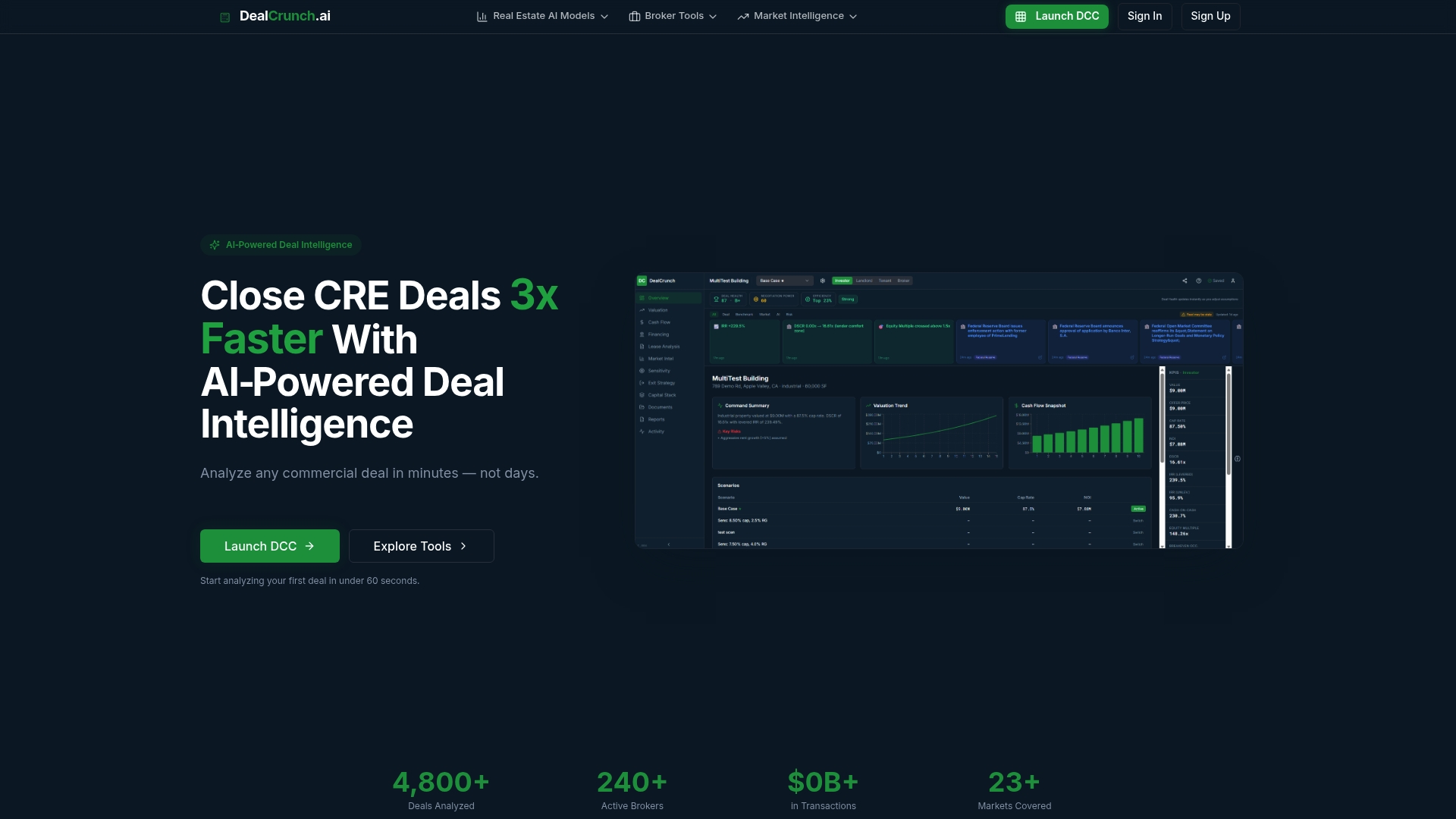
Integrate capital stack modeling, waterfall distributions, and sensitivity diagnostics seamlessly within one workspace. No more juggling disconnected tools or rebuilding calculations manually. The platform handles complex scenarios while you focus on negotiation strategy and client relationships, ultimately closing more deals with greater confidence and precision.
Experience how advanced CRE scenario analysis transforms your underwriting workflow. Professional PDF exports and shareable deal links mean your scenarios impress investors and close transactions faster. The CRE financial modeling tools you need, unified in one powerful command center built specifically for commercial real estate professionals.
FAQ
What are the most important scenarios to model in CRE leasing negotiations?
Rent concession variations and net effective rent scenarios prove most critical in leasing negotiations. Model tenant improvement allowances, free rent periods, and rental escalations across at least three levels to reveal total occupancy costs and support data-driven lease structuring for both landlords and tenants.
How does capital stack scenario analysis impact investor decision making?
Capital stack scenarios show how different financing structures affect IRR, cash flow distributions, and payout priority across equity and debt positions. This transparency helps investors select positions matching their risk tolerance while enabling syndicators to structure deals appealing to diverse capital sources with varying return requirements.
Can AI tools really speed up CRE scenario analysis?
AI-powered scenario platforms deliver 3x faster analysis iteration and 20% higher accuracy compared to manual spreadsheet methods according to industry research. Real-time calculation updates during negotiations eliminate delays, while automated visualizations improve stakeholder comprehension and accelerate deal closure timelines significantly.
How can I combine sensitivity analysis with scenario modeling?
Overlay sensitivity diagnostics on each scenario by testing how individual variable changes affect outcomes within best, base, and worst cases separately. This reveals which assumptions drive results most significantly under different conditions, exposing model weaknesses and reducing underwriting errors by up to 40% through targeted validation efforts.
Why do market condition scenarios matter for CRE valuations?
Market condition scenarios quantify how rent growth rates, vacancy levels, and cap rates affect property values and investment returns across economic cycles. This range-based analysis replaces single-point forecasts with realistic outcome distributions, supporting confident pricing decisions and transparent risk communication to investors and lenders.